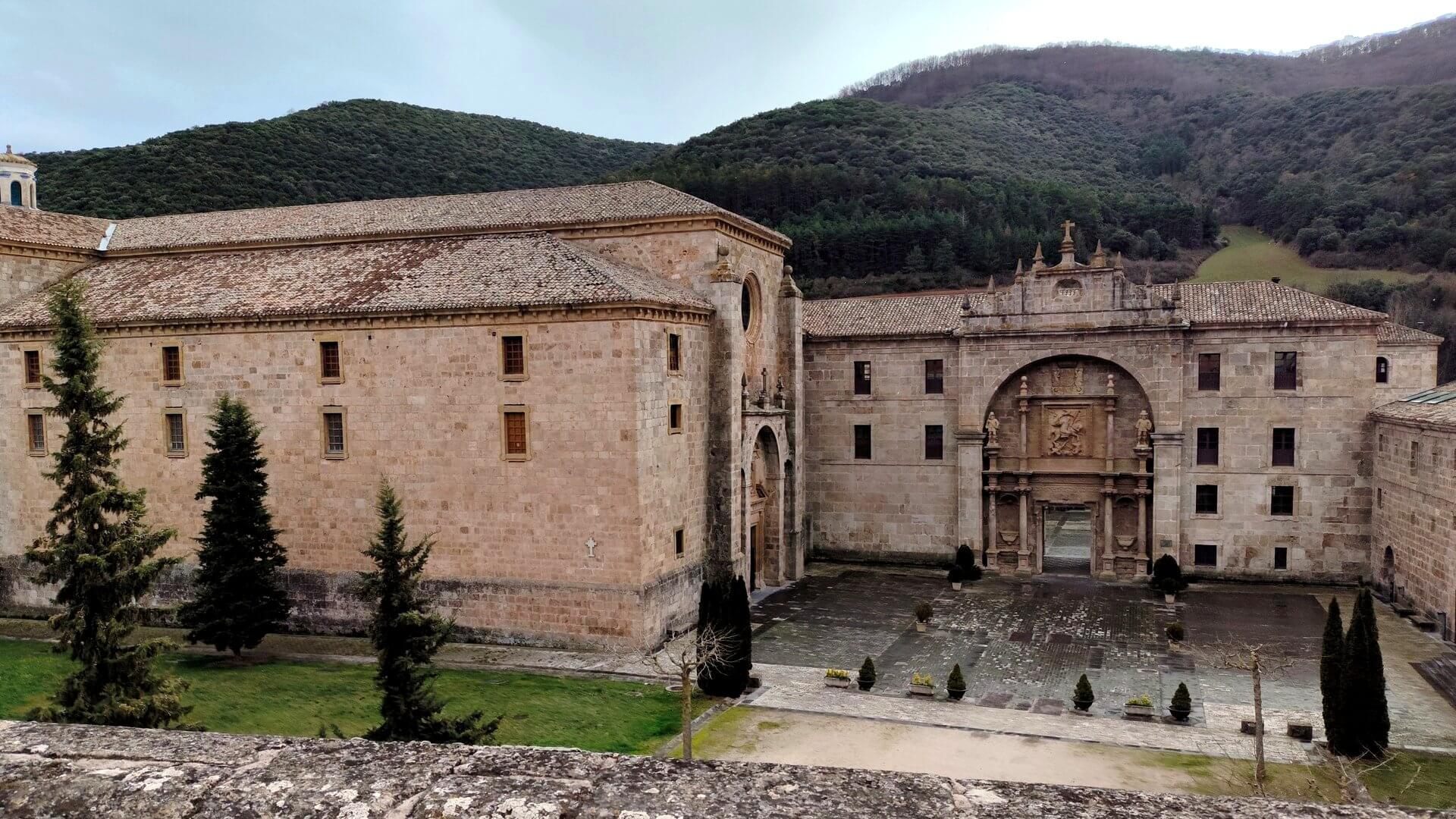
The AutorIA exhibitionis now open to visitors at the Monastery of Yuso, in San Millán de la Cogolla (La Rioja, Spain). Proasur took part in bringing it to life through a joint venture with Studio Etérea, which was responsible for the museographic design.
It is the monastery’s new museographic offering, promoted by the Government of La Rioja as part of the Valle de la Lengua project. It is also part of the Tourism Sustainability Plan in Destinations, funded by the European Union through NextGenerationEU.
What the AutorIA exhibition explores
The AutorIA exhibition creates a route through written culture, the evolution of the Spanish language and the historical significance of Yuso. It begins with monastic life in the Emilianense monasteries and extends to the emergence of artificial intelligence.
To do so, it combines heritage, historical objects, graphics, exhibition furniture and technology. The project also coincides with the centenary of Orígenes del español (“Origins of Spanish”). In this work, Ramón Menéndez Pidal identified San Millán as a key place for understanding the birth of the language.
Proasur’s role in the AutorIA exhibition
Proasur’s work focused on the technical development, production, manufacturing and installation of the museographic elements. These elements transformed the different spaces along the route into exhibition rooms. Proasur also took on the coordination and integration of the museographic, graphic, exhibition and audiovisual resources.
The work includes display cases, plinths and exhibition furniture, as well as panelling, museographic supports and structures. It also covers the integration of graphics, lighting associated with the exhibition elements and a range of audiovisual resources.
Work across numerous rooms of the monastery
The work extends across numerous spaces of the monastery. These include the Hall of Kings, the Cells, the Codex Room, the Sala Preciosa and the Museum. They also include the rooms devoted to the evolution of the language and to the Glosses, the Library, the central hallway, the Refectory and the cloisters.
In this way, visitors explore the building itself while discovering the history it holds.
Integrating the AutorIA exhibition into a historic building
The Monasteries of Suso and Yuso have been a UNESCO World Heritage Site since 1997. For this reason, one of the main challenges has been to integrate the new museography in a way that is compatible with the existing architecture.
To achieve this, the construction and installation solutions have been adapted to the particular features of each room. Likewise, the electrical installation and network cabling required specific solutions for a protected building.
With AutorIA, Proasur adds a new project to its track record in museum production and interpretation centres. After more than 35 years working in cultural spaces, the company reaffirms its commitment to bringing heritage to life. This commitment is backed by its management system, certified to ISO 9001 and ISO 14001.
Full visitor information is available on the official AutorIA website.
Every historic building presents a unique challenge. [Tell us about yours.]